
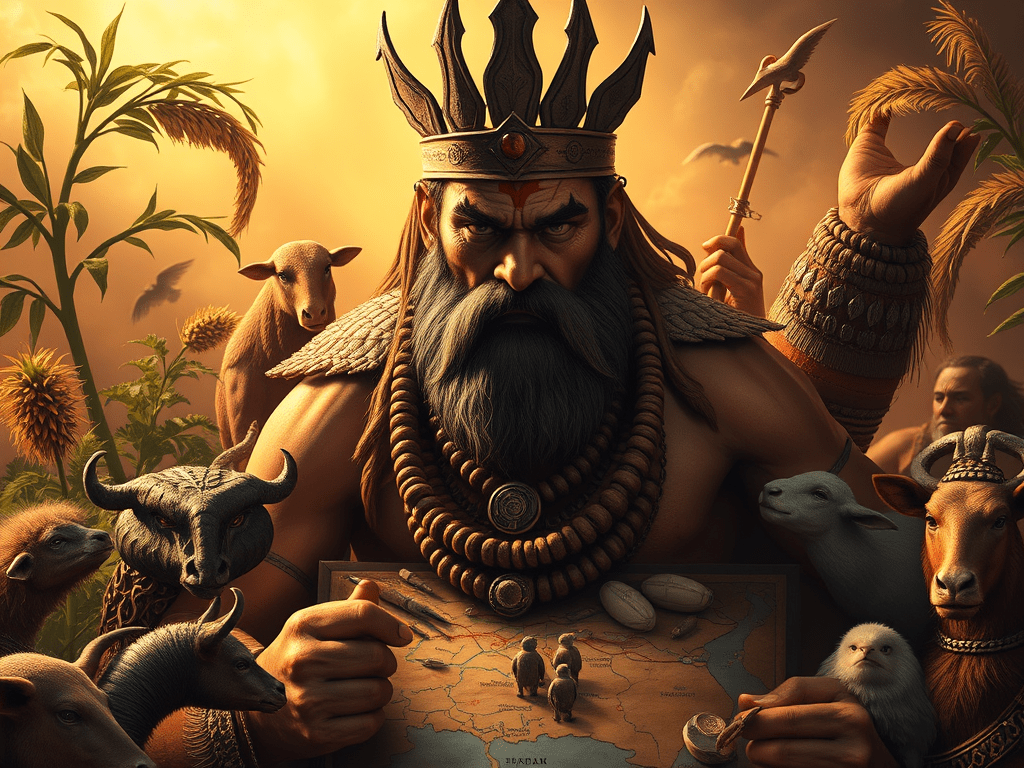
Throughout history, alphas have controlled the three basic requirements of survival: food, sex, and territory. As human cognition evolved, those in power, such as kings and rulers, often secured their dominance by aligning themselves with divinity or declaring themselves gods outright. Ancient Egypt provides an excellent example of this practice. Pharaohs were not merely rulers; they were gods incarnate, wielding divine authority to justify their control over resources, people, and land.
This idea of a “man-based god” reflects the tribal structure of early human societies. These gods were deeply concerned with securing food, sex, and territory for their people—and themselves. To maintain control, they relied on aggression, intimidation, and the promise of divine punishment or reward.
As societies transitioned from nomadic to agrarian lifestyles, and later to complex civilizations, the role of gods evolved to reflect changing needs and societal structures. The gods of small tribes were replaced by more powerful deities that could command larger groups of people. These new gods adapted to maintain control over their increasingly sophisticated followers.
For instance, the history of Israel shows a fascinating shift from polytheism to monotheism, driven by societal changes and the need for unified leadership. Similarly, in Christianity, the Roman Emperor Constantine used religion to consolidate his empire. By converting to Christianity and promoting it as the state religion, he wielded it as a tool for political control and expansion.
Islam offers another striking example of religion as a means of domination. The Islamic God, Allah, monopolized food, sex, territory, and commerce for one man: Muhammad. As a dominant male figure, Muhammad used religion to unite warring tribes under one banner, granting himself authority and ensuring his dominance. After his death, the expansion of Islam followed the same principles: conquering territories, amassing wealth, and asserting control over women and resources.
Religions have long been tools of power and control, created and perpetuated by monarchs and leaders to ensure their survival and dominance. From David and Constantine to Muhammad and Suleiman, rulers have wielded religion to justify their authority, suppress dissent, and maintain order.
This isn’t just ancient history. The same dynamics persist today. Religious institutions often align with political powers, creating systems that perpetuate control over people’s lives. Whether it’s the promise of salvation or the threat of damnation, religion serves to manipulate human behavior in ways that benefit those in power.
So next time you’re tempted to say a prayer, attend a church service, or observe the Sabbath, ask yourself: Who is really in control? Is it about morality and salvation, or is it about power and survival? Are you a pure soul in the eyes of God, or are you just a pawn in a game of domination and control?
Religion, when stripped of its divine facade, reveals itself as a deeply human construct—one rooted in our primal instincts and societal needs. It’s not about heaven or hell; it’s about who holds the reins of power and who benefits from your submission. As we explore the intricate tapestry of religious beliefs, we find that they often serve as tools for establishing social order, creating moral frameworks, and legitimizing authority. The rituals, doctrines, and myths collectively reinforce the structures that govern our interactions and relationships, often providing comfort and a sense of community. Yet, beneath this comforting veneer lies a complex interplay of control and influence, where those in positions of power manipulate spiritual narratives to maintain their dominance, reminding us that at the core of religion is not just faith, but a reflection of human ambition and the yearning for significance within a larger narrative.
 Decent atheist
Leave a comment